

Move-out season is a volume problem, not a junk problem
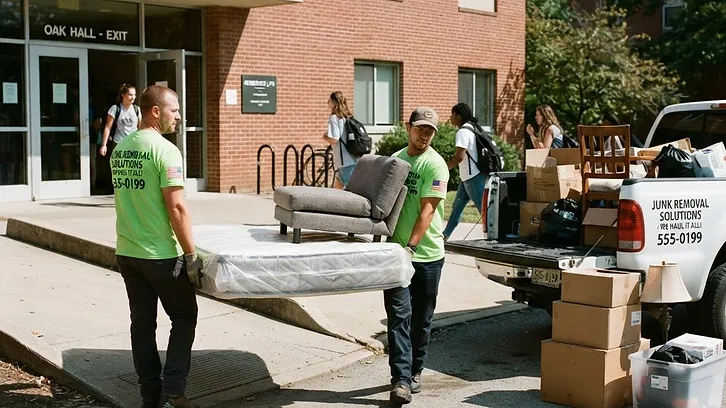
Every property manager who has survived a spring turn knows the shape of it: fifty, a hundred, three hundred units emptying in the same seven-to-ten day window, with the next lease cycle starting almost immediately behind it. What gets left behind is not a bag of trash here and there. It is futons wedged in stairwells, mini fridges abandoned in common rooms, mattresses stacked by the dumpster corral until the corral disappears under them.
The numbers back up what you see on the ground. The average college student generates roughly 640 pounds of waste per year, and the sharpest spike lands during spring move-out. Multiply that across a single mid-size student housing property and you are staring at tens of tons of material that has to leave the property in days, not weeks.
Universities feel it at an even bigger scale. Tufts University alone discards more than 230 tons of waste annually during its graduation and move-out periods. That is one campus. Housing departments everywhere face the same compressed calendar: units must be inspected, cleared, cleaned, and turned before the next cohort arrives, and every day a unit sits full of abandoned furniture is a day it cannot be turned.

Planning for move-out season? Get a cleanout program scoped before the rush hits.
Get your instant price
Enter your ZIP to see live pricing
No obligation. See your price first.
Rated 4.9/5 across 1k+ Atlanta jobs
Why the usual approaches break down
Most properties handle move-out one of three ways, and all three strain at volume. Maintenance staff get pulled off work orders to haul furniture, which burns your most expensive labor on your lowest-skill task. A single junk removal franchise gets called, quotes by the truckload, and becomes a bottleneck when three buildings need service the same morning. Or a rotating cast of Craigslist haulers shows up in unmarked trucks, with no insurance certificate on file and no one to call when a load ends up dumped somewhere it should not be.
None of these fail because people are not working hard. They fail because move-out is a logistics problem - many crews, many buildings, one deadline - being solved with tools built for one-off pickups.
What a scheduled, high-volume cleanout actually looks like
WasteMatch runs move-out as a program, not a series of phone calls. Before the window opens, we scope the property with you: unit count, expected volume, staging areas, elevator and access constraints, and the turn calendar you are working against. From that we build a schedule - which buildings get crews on which days, where dumpsters or trailers get staged for self-service loading, and where full-service crews do the carrying.
Every crew that touches your property is background-checked and dispatched through our platform, so you know who is on site and when. Pricing is set up front - no truckload-by-truckload haggling in week two when everyone is exhausted. And because dispatch, tracking, and billing all run through one system, your housing office deals with one vendor and one invoice instead of a stack of them.
There is also a better ending available for a lot of this material. The University of Michigan's move-out donation program diverted over 16 tons of reusable items in a single year - proof that a meaningful share of what students leave behind is donatable, not landfill. WasteMatch supports donation routing for good-condition items, so your property's move-out numbers can include a diversion story, not just a disposal bill.
Planning for move-out season? Get a cleanout program scoped before the rush hits.
Get your instant price
Enter your ZIP to see live pricing
No obligation. See your price first.
Rated 4.9/5 across 1k+ Atlanta jobs
Built for the calendar you actually live on
Student housing does not need a hauler in July the way it needs one in May. Our model is built for that seasonality: you are not paying to keep a vendor on retainer through the quiet months, and you are not scrambling to find capacity when the spike arrives. The scheduling, the crews, and the pricing scale up for the window and scale back down after it.
That same structure covers the smaller, year-round needs too - the mid-semester abandonment, the RA-reported furniture pile, the summer renovation cleanout. One account, one standard of service, whatever the volume.