Debris Removal · Junk Removal · Dumpster Rental · Property Managers · Atlanta
Debris Removal Service: What Types of Debris Each Service Type Covers
WasteMatch Team · August 21, 2026
Written and maintained by the WasteMatch Team — Atlanta metro haulers and dispatchers who handle disposal compliance every day. Last updated .
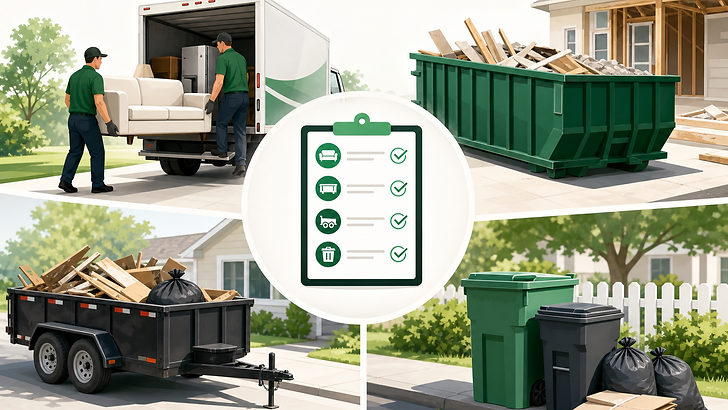
Debris removal isn't a single service. The term covers everything from a broken recliner in a spare bedroom to a yard full of storm-damaged branches to a construction site with concrete rubble and drywall scraps. Each of those jobs requires a different service type, different equipment, and in some cases different disposal compliance.
Booking the wrong service type means getting turned away on pickup day or paying for capacity you don't need. This article maps each major debris removal service type to the debris it actually covers, so you can match your job to the right option before you book.
The Four Main Debris Removal Service Types
Most debris removal jobs fall into one of four categories: full-service junk removal, dumpster rental, trailer rental, or curbside pickup. Each works differently and covers different debris.
Full-Service Junk Removal
A hauler comes to your location, loads everything, and hauls it away. You don't touch the debris. The crew handles the labor from wherever the items sit — a second-floor bedroom, a garage, a backyard.
Debris this service covers:
- Household junk (mixed loads, general clutter, miscellaneous furniture)
- Furniture (sofas, bed frames, dressers, mattresses)
- Appliances (refrigerators, washers, dryers, dishwashers, stoves)
- Electronics (TVs, monitors, computers, printers)
- Yard waste (branches, brush, bagged leaves, small landscaping debris)
- Exercise equipment (treadmills, weight benches, ellipticals)
- Hot tubs (above-ground; in-ground units typically require a custom quote)
- Estate and cleanout loads (full-room or full-property clearing)
- Eviction and unit turnover debris (furniture, appliances, and personal property left behind)
Full-service removal is the right call when debris is heavy, bulky, or spread across multiple rooms. It's also the only option when you or your tenants can't physically move items to a staging area.
At WasteMatch, full-service removal is priced by item type. Household junk starts at $69, furniture at $80, appliances at $92, and hot tub removal at $325. The price is locked in at booking as long as the job matches the description you provide.
Dumpster Rental
A roll-off container is dropped at your property. You load it on your schedule. The hauler returns to pick it up when you're done.
Debris this service covers:
- Renovation debris (drywall, flooring, tile, lumber, insulation)
- Construction waste (framing scraps, roofing material, concrete in smaller volumes)
- Mixed household cleanouts where you're doing the labor yourself
- Yard and landscaping debris in volume (tree removal, sod, brush piles)
- Garage or storage unit cleanouts
- Multi-day projects where debris accumulates over time
Dumpster rental makes sense when a job spans multiple days, when you're doing your own demo or renovation work, or when you need a central collection point on a job site. It's not designed for single heavy items like appliances or hot tubs — those are better handled by full-service removal.
Dumpster rentals through WasteMatch start at $295 and are bookable through the same platform as full-service removal. No separate vendor required.
Trailer Rental
Structurally similar to dumpster rental — you load it, the hauler retrieves it — but with a trailer instead of a roll-off container.
Debris this service covers:
- The same categories as dumpster rental in most cases
- Situations where a roll-off container won't fit (tight driveways, HOA-restricted properties, narrow access points)
- Smaller-volume renovation and cleanout loads that don't justify a full dumpster
Trailer rentals also start at $295 through WasteMatch. If your property has access limitations that rule out a standard roll-off, a trailer is often the practical alternative.
Curbside Pickup
The lowest-friction option: you move items to the curb, a hauler collects them. Some services in this category operate at a flat per-item rate.
Debris this service covers:
- Furniture and bulk items you can physically move to the curb
- Electronics and small appliances
- Bagged yard waste in some cases
What curbside pickup does not cover:
- Heavy appliances you can't move without equipment
- Items on upper floors or in basements
- Customers with mobility limitations
- In-home or in-garage debris that can't be staged outside
Curbside is the most affordable option for straightforward jobs where you can handle the staging yourself. It's not a substitute for full-service removal when debris is heavy or inaccessible.
Debris Categories That Often Cause Confusion
Some debris types don't fit neatly into one service type. These generate the most questions.
Construction and Renovation Debris
Light renovation debris — drywall, flooring, lumber scraps — fits in a dumpster or trailer rental. Heavy construction debris, including concrete, brick, and large volumes of roofing material, may require a custom quote because of weight limits on standard roll-off containers.
If you're managing a renovation cleanout as a property manager, the guide to consolidating waste vendors covers how to handle dumpster service, unit cleanouts, and bulk removal through a single booking flow rather than coordinating separate vendors.
Appliances
Appliances require full-service removal in almost every case. They're too heavy to stage curbside, and they contain refrigerants or other materials that require proper disposal handling. Loading a refrigerator into a dumpster is also a disposal compliance issue in most jurisdictions.
Electronics
Electronics (e-waste) are accepted by full-service removal haulers and some curbside services. They don't belong in dumpsters or trailers because of environmental disposal regulations. Electronics removal through WasteMatch starts at $78.
Yard Waste
Yard waste can go either way. Small volumes — a few bags of leaves, a pile of branches — are handled efficiently by full-service removal starting at $74. Large volumes from a major tree removal or landscaping project are better suited to a dumpster rental, where you can load debris over several days.
Eviction and Unit Turnover Debris
This is a full-service removal job by default. The debris is inside the unit, often includes appliances and furniture, and needs to be cleared before the unit can be shown or re-leased. A dumpster in the parking lot doesn't solve the problem when the items are on the third floor.
For property managers handling recurring turnover, the foreclosure cleanout services overview covers what full-property clearing typically involves and how pricing works for larger jobs.
Matching Your Debris to the Right Service
| Debris Type | Full-Service Removal | Dumpster/Trailer Rental | Curbside Pickup |
|---|---|---|---|
| Furniture | Yes | Load-it-yourself | If you can move it |
| Appliances | Yes | Not recommended | Not recommended |
| Electronics | Yes | No | Some services |
| Household junk (mixed) | Yes | Yes | Yes (eligible items) |
| Renovation debris | Smaller loads | Yes | No |
| Yard waste | Smaller volumes | Larger volumes | Some services |
| Hot tub (above-ground) | Yes | No | No |
| Eviction/turnover debris | Yes | Supplemental only | No |
| Construction waste (heavy) | Custom quote | Custom quote | No |
What Triggers a Custom Quote
Most debris removal jobs fit standard pricing. A few don't.
Jobs that typically require a custom quote: in-ground hot tub removal (excavation involved), very large volume loads, debris with hazardous material concerns, and jobs with significant access challenges — no elevator, tight stairwells, restricted site access.
WasteMatch routes non-standard jobs through a custom quote flow rather than forcing them into the standard price builder. For everything else, the price you see before booking is the price you pay.
For Property Managers: Matching Service Type to Your Workflow
Unit turnover debris is a full-service removal job. The items are inside the unit, often heavy, and need to be cleared fast. Every day a unit sits vacant costs money.
Dumpster rental works as a supplement during larger renovation cycles or when you're doing demo work across multiple units at once. It's not a replacement for full-service removal when items need to be carried out of a unit.
The most efficient setup for a multifamily property is both service types available through the same platform — booked without phone calls, with a guaranteed price before dispatch. That's what WasteMatch is built for. See how it works for junk removal in Atlanta, or enter your zip code at wastematch.com to see your price.
FAQs
What is a debris removal service? It's a broad term covering any professional pickup and disposal of unwanted material. That includes full-service junk removal (crew loads everything), dumpster and trailer rentals (you load, they haul), and curbside pickup (you stage items, they collect). The right service type depends on what you're removing, how much there is, and whether you can do the staging work yourself.
Can I put appliances in a dumpster rental? Generally no. Appliances often contain refrigerants and other regulated materials that require proper disposal handling. Most dumpster rental terms exclude appliances outright, and improper disposal can create compliance liability. Full-service removal is the right option — a hauler who handles disposal correctly.
What debris is not accepted by most junk removal services? Hazardous materials — paint, chemicals, asbestos, biohazardous waste — are excluded by most standard junk removal services. Large volumes of heavy construction debris like concrete and brick may also require a custom quote rather than standard pricing.
What's the difference between a dumpster rental and a trailer rental? Both work the same way: you load the container, the hauler retrieves it. The difference is physical size and access. Trailers are typically smaller and lower to the ground, making them easier to load and better suited to tight driveways or properties where a full roll-off container won't fit.
How do I know which debris removal service type I need? If the items are inside a building and you can't move them yourself, book full-service removal. If you're doing a multi-day project and generating debris over time, book a dumpster or trailer rental. If you can physically stage items at the curb and they're eligible, curbside pickup may be the most cost-effective option.
Does one service cover all types of debris? No. Full-service removal covers the widest range — heavy appliances, furniture, electronics, yard waste. Dumpsters and trailers are better for renovation and construction debris loaded over multiple days. Curbside works only for items you can move yourself.
Can property managers book debris removal for multiple units at once? Yes. WasteMatch supports property manager bookings for unit turnover, eviction cleanouts, and bulk removal across multifamily properties in the Atlanta metro. Each job gets a guaranteed price before dispatch. No estimate calls required.
The right debris removal service depends on what you're removing and who's doing the loading. Get the service type right before you book, and the rest of the process is straightforward. Enter your zip code at wastematch.com to see your price.
References
- U.S. EPA — Facts and Figures about Materials, Waste and RecyclingU.S. Environmental Protection Agency
- U.S. EPA — Sustainable Management of Construction and Demolition MaterialsU.S. Environmental Protection Agency
- Georgia EPD — Land Protection Branch, Solid Waste ManagementGeorgia Environmental Protection Division
- City of Atlanta — Bulk Waste Collection RulesCity of Atlanta
- City of Atlanta — Recycling Process and Accepted MaterialsCity of Atlanta
- Atlanta DOT — Dumpster and POD Right-of-Way PermitsAtlanta Department of Transportation
- Georgia EPD — Regulated Solid Waste FacilitiesGeorgia Environmental Protection Division
The WasteMatch Team — Atlanta haulers & dispatchers
WasteMatch was built by people who did the removals themselves — one pickup truck and a borrowed trailer, hauling junk for Atlanta neighbors on nights and weekends. We started the platform to fix what we kept running into: vague estimates, no-shows, and week-long waits. Our team runs dispatch and the hauler network, and sets the pricing and payout standards every job on WasteMatch follows.
Our editorial guides are checked against the primary sources linked in each article and updated when operating details or public guidance change.
View the WasteMatch Team author profile →See your guaranteed price in under a minute
No phone calls, no estimates, no surprises. Pick your items and book a vetted Atlanta pro online.