Porter Services · Property Managers · Atlanta · Hospitality · Hotels · Motels
Hotel & Motel Porter Services: A Better Atlanta Arrival
WasteMatch Team · October 7, 2026
Written and maintained by the WasteMatch Team — Atlanta metro haulers and dispatchers who handle disposal compliance every day. Last updated .
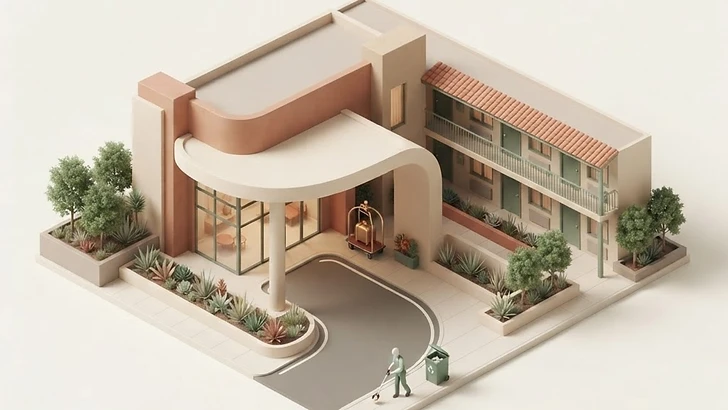
Editorial illustration, not a photograph of a client property.
A guest starts evaluating a hotel before reaching the front desk. The arrival drive, parking space, exterior walkway, and route past the waste enclosure all form part of that experience. For an Atlanta hotel or motel, exterior porter service addresses a specific operational gap: keeping those shared outdoor areas clear of litter and agreed debris without repeatedly pulling staff away from their primary jobs.
Here, porter service means exterior grounds cleanup, not luggage handling or guest-room housekeeping. WasteMatch offers one-time exterior property cleanup and custom recurring programs. It does not replace your bell team, room attendants, overnight security, or daily property inspections.
This guide is for independent motel owners, hotel general managers, regional operators, and hospitality asset managers who need a practical scope rather than an unsupported promise that cleaner grounds automatically raise room rates.
See WasteMatch’s hospitality-ready exterior service scope, or request a recurring-service conversation.
Start with the guest journey, not the dumpster
An efficient walkthrough follows the route a guest actually takes. Walk from the vehicle entrance to a parking space, then to the lobby or exterior room corridor. Repeat the trip from accessible parking and from the rideshare drop-off. Note where discarded packaging collects and who is currently responsible for removing it.
Then walk the less visible operating route: deliveries, employee entry, loading area, waste enclosure, and the path used to move collected debris. A clean front drive with persistent overflow behind the building is an incomplete plan. A cleanup route that blocks arriving guests is also a poor fit.
At a Downtown Atlanta hotel, access planning may involve a constrained loading area and busy arrival periods. At a motel with exterior corridors, the issue may be a much longer outdoor guest path. These are illustrative operating patterns, not descriptions of specific WasteMatch clients.
Hotels, motels and extended-stay properties need different scopes
| Property format | Exterior priority | Coordination question |
|---|---|---|
| Downtown business or convention hotel | Arrival canopy, parking approach, loading edge | When can cleanup occur without obstructing arrivals or deliveries? |
| Exterior-corridor motel | Parking perimeter, stairs and agreed outdoor corridors | Which routes must remain available while work takes place? |
| Extended-stay property | Shared outdoor areas and recurring packaging hotspots | What belongs in the routine scope versus a separate bulk pickup? |
| Hotel with meeting space | Agreed outdoor gathering areas and post-event litter | Who handles event waste, and who authorizes work outside the base scope? |
Food-service waste, grease, pest treatment, pressure washing, and hazardous materials should not be folded into a general litter-removal promise. Assign those tasks to the appropriate existing contractor or qualified provider. Exterior cleanup is not a sanitation certification for a kitchen or pool.
For guestrooms being renovated, furniture replacement is a separate project. Inventory the items and access constraints rather than assuming a recurring grounds visit includes a hotel-wide furniture haul-out.
Schedule around operations without promising round-the-clock coverage
Ask the front desk, housekeeping lead, engineering team, and waste contractor where their work overlaps. One person should approve the route and serve as the on-site contact. Provide safe parking instructions, gate access, approved staging locations, and any quiet-hour limitations before the visit.
WasteMatch discusses monthly, every-other-month, and quarterly recurring programs. Those are periodic exterior-care options, not continuous day-porter staffing. A high-traffic hospitality property may need its own daily litter pickup and immediate hazard response between visits. Do not leave a spill or blocked route until the next scheduled contractor visit.
If arrivals, a conference, or an event changes the workload, review scope and availability in advance. A requested window is not a promise of overnight availability or guaranteed event coverage. Keep emergency response with the property's established procedures.
Use the recurring inquiry form to start the conversation; the team can discuss operational details during follow-up. The form is not a reservation for a recurring slot.
Measure guest experience without inventing revenue attribution
There is a reasonable operational case for presenting a cared-for property. There is not enough information in a litter pickup log to claim an occupancy lift, a higher average daily rate, or fewer guest refunds.
Begin with metrics you can observe: exterior-condition complaints, repeat problem zones, staff callouts, and completion of the agreed route. Track reviews that specifically mention exterior conditions, but do not treat all changes in review score as an effect of porter service.
For cost comparisons, normalize by activity. If an illustrative hotel spends $900 on exterior cleanup during a month with 3,000 occupied room nights, its cost is $0.30 per occupied room night. The $900 is a made-up budget, not a WasteMatch price. Use the same included expenses and denominator in each reporting period.
Comparing $900 in a sold-out month with $700 in a quiet month without adjusting for activity can produce the wrong conclusion. Weather, guest mix, events, construction, and changes to in-house coverage can also affect conditions.
A conservative investment test for hotel ownership
Evaluate the program using avoided cash costs first: reactive cleanup bills eliminated, paid overtime reduced, or duplicate work removed from another contract. Recovered front-desk or engineering time is valuable capacity, but it is not a payroll saving if wages stay unchanged.
If ownership wants a revenue sensitivity test, use incremental contribution, not gross room revenue. Hypothetically, a $900 monthly cost would need 15 genuinely incremental room nights at $60 contribution per night to break even on that basis alone. Contribution means the amount remaining after the variable expenses associated with those additional room nights.
This is only a break-even illustration. It does not claim porter service produces those bookings. A defensible operating budget should not depend on an unmeasured assumption that a cleaner parking lot generates fifteen new reservations every month.
For the broader property-investment framework, read Porter Services ROI and NOI. Keep any unproven guest-experience upside outside your base-case savings estimate.
Separate cleanup documentation from sustainability reporting
After-service photos can show that a specified area was cleared. They cannot show how many kilograms of waste were recycled or whether the hotel met a brand sustainability target.
The Hotel Waste Measurement Methodology, developed by WWF-US and Greenview with industry support, describes consistent boundaries, measurement, verification, and reporting. It includes total waste, waste per square meter, and diversion metrics. A property may track other internal measures, but it should keep the methodology and measurement basis clear.
ENERGY STAR’s waste-tracking resources also distinguish disposal, recycling, composting, and reuse. Use actual provider records or clearly labeled estimates; do not call a bag count a verified recycling weight. WasteMatch’s service does not automatically include a hotel sustainability audit or reporting certification.
A manageable handoff after every visit
Have the on-site contact confirm three things: the agreed zones were completed, any exclusions were recorded, and any additional work was approved before billing. Review photos without exposing guest faces, license plates, room numbers linked to guests, or personal belongings unnecessarily.
If a location repeatedly needs cleanup, investigate why. A poorly placed bin, unclear guest instructions, a delivery practice, or an inadequate container schedule may be creating the problem. The EPA recommends preventing waste at the source, not simply removing the same avoidable waste more often.
A recurring porter plan should complement that improvement work. It should not become a reason to ignore a broken enclosure door or an overflowing container contract.
Choose the right starting point for your property
For an accumulated exterior backlog, visit Porter Services and choose Price My Property. One-time visits start from $499 for up to 50,000 square feet, plus a standard service fee; review the full price and included time before booking. Do not assume guest-room floor area is the service footprint or that every material is included.
For ongoing care, complete the recurring-service inquiry. Provide the property name or address and your preferred schedule. Approximate square footage is optional. Custom pricing depends on the agreed property, scope, and frequency; submitting the form does not create a charge or booking.
Frequently asked questions
Does hotel porter service include luggage handling or housekeeping?
Not in this WasteMatch offering. The service is exterior grounds cleanup and agreed debris removal, not bell service, room cleaning, or an on-site staffed hospitality role.
Can a motel request recurring exterior cleanup?
Yes. Motels can inquire about a custom monthly, every-other-month, or quarterly program. Daily property care between visits remains the operator's responsibility.
Will porter service increase occupancy or room rates?
No increase is guaranteed. Measure specific operating outcomes and treat revenue effects as unproven unless your own analysis supports them.
Do I need exact square footage to inquire?
No. Approximate square footage is optional on the recurring-service form. Confirm the actual service footprint before accepting a scope or booking.
References
- Managing and Reducing Wastes: A Guide for Commercial BuildingsU.S. Environmental Protection Agency
- Waste Tracking and Management in Commercial BuildingsENERGY STAR
- Hotel Waste Measurement MethodologySustainable Hospitality Alliance, WWF-US and Greenview