Dumpster Rental · Atlanta · Pricing · Guide
Roll-Off Dumpster Rental: Sizes, Costs, and What the Delivery Driver Won't Tell You
WasteMatch Team · August 30, 2026
Written and maintained by the WasteMatch Team — Atlanta metro haulers and dispatchers who handle disposal compliance every day. Last updated .
- What a Roll-Off Dumpster Is (and Isn't)
- Roll-Off Dumpster Sizes: What Each One Actually Holds
- How Roll-Off Dumpster Rental Pricing Actually Works
- The Weight Limit Problem Nobody Explains Clearly
- Placement Rules: What the Driver Won't Move For You
- Rental Period: How Long Do You Actually Get?
- What You Cannot Put in a Roll-Off Dumpster
- Roll-Off vs. Trailer Rental: Which One Fits Your Job
- Property Managers: Dumpster Rentals at Scale
- How to Book a Roll-Off Dumpster Through WasteMatch
- Frequently Asked Questions
Most first-time renters focus on one question: what size do I need? That's the right instinct. But size is only part of the decision. Weight limits, prohibited items, placement constraints, overage fees, rental period terms — that's where most jobs go sideways. And that's what the delivery driver usually doesn't mention.
This guide covers roll-off dumpster rental from the ground up: sizes, realistic costs, what actually drives the final bill, and the details that rarely make it into a booking confirmation.
What a Roll-Off Dumpster Is (and Isn't)
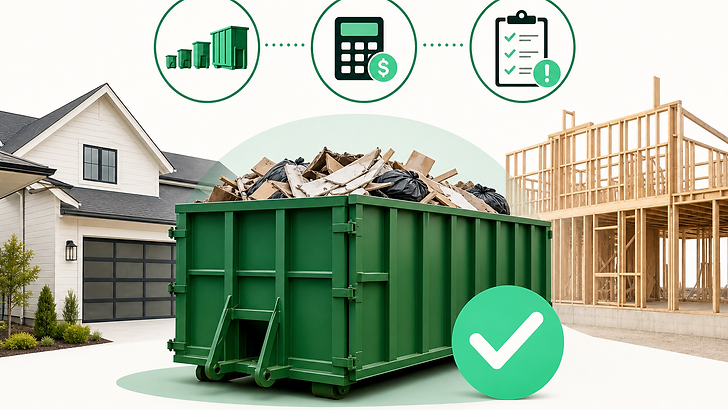
A roll-off dumpster is an open-top container delivered by a truck with a hydraulic roll-off system. The container slides off the truck bed and sits on your driveway, parking lot, or job site for the duration of the rental. When you're done, the truck returns, rolls it back on, and hauls it to a disposal facility.
That's the mechanics. What it isn't: a service where someone carries things for you. You load it yourself. If you want a crew to handle the lifting and hauling, that's full-service junk removal — a different product with a different price structure.
Roll-offs work best for projects where debris builds up over multiple days: renovations, roofing tear-offs, cleanouts, landscaping overhauls, construction work. If you have a one-time load and want it gone in an afternoon, a hauler dispatch usually makes more financial sense.
Roll-Off Dumpster Sizes: What Each One Actually Holds
Container sizes are measured in cubic yards — the volume of a cube three feet on each side. A 10-yard dumpster holds ten of those cubes. That's abstract, so here's what each common size translates to in practice.
10-Yard Dumpster
Roughly three pickup truck loads. Good for small cleanouts: a single-car garage, a bathroom renovation, a deck teardown. Not the right call for whole-house cleanouts or roofing jobs on larger homes.
Dimensions typically run around 14 feet long, 7.5 feet wide, and 3.5 feet tall. The low walls make it easier to toss heavy items over the side without straining.
15-Yard Dumpster
A step up from the 10 — useful for medium-scale cleanouts or a kitchen remodel. Holds roughly four to five pickup truck loads. If you're unsure whether a 10 will cut it, the 15 is usually the safer call. The price difference is smaller than the cost of ordering a second container.
20-Yard Dumpster
The most commonly rented size for residential projects. Holds approximately six pickup truck loads. Works well for whole-room renovations, large garage cleanouts, and mid-sized landscaping jobs. Dimensions typically run around 22 feet long, so you need a clear run of driveway.
30-Yard Dumpster
Standard on construction sites and large-scale renovations. Holds roughly nine to ten truck loads. At this size, placement becomes a real logistical consideration — you need a firm, level surface with enough overhead clearance for the delivery truck.
40-Yard Dumpster
The largest standard size. Used for commercial demolition, major construction projects, and large estate cleanouts. Most residential driveways can't safely accommodate one. If you're renting a 40-yard, you already know you need it.
How Roll-Off Dumpster Rental Pricing Actually Works
Pricing is less straightforward than most companies make it appear. The base rental rate is real, but it's rarely the only number that matters.
Here's what typically goes into the final bill:
Base rental rate — covers delivery, pickup, and a set number of days (usually 7 to 14, depending on the provider). This is the number advertised.
Weight allowance — every container comes with a tonnage limit built into the base price. Exceed it and you pay an overage fee, typically per ton. A 10-yard might include one ton; a 30-yard might include three. Load heavy materials — concrete, dirt, tile, roofing shingles — and you can hit that limit faster than you'd expect.
Extended rental fees — if your project runs longer than the included rental period, you pay a daily or weekly extension fee. On larger renovations, this adds up.
Prohibited item fees or rejection — most dumpsters prohibit certain materials: tires, mattresses, paint, batteries, hazardous chemicals, electronics, and in some cases appliances with refrigerants. Loading prohibited items can trigger a sorting fee at the facility, or get the load rejected entirely.
Fuel and environmental surcharges — these show up as line items on many invoices and aren't always disclosed upfront.
At WasteMatch, dumpster and trailer rentals start from $295. The price shown in the booking flow is the price you pay when the job matches the description at booking — no callbacks to confirm, no estimate visit, no surprise line items after delivery.
The Weight Limit Problem Nobody Explains Clearly
This is where most first-time renters get caught off guard. A container's weight limit is not the same as its volume capacity.
Fill a 10-yard dumpster to the brim with light materials — wood scraps, cardboard, foam — and you might not come close to the weight limit. Fill the same container halfway with concrete rubble and you can blow past it entirely.
Heavy materials that commonly cause overages:
- Concrete and masonry
- Soil and gravel
- Roofing shingles (especially multiple layers)
- Ceramic and porcelain tile
- Wet debris after rain
If your project involves any of these, ask specifically about the weight allowance before booking, and get the overage rate in writing. Overage rates vary by provider and facility, so get the included weight and per-ton overage rate in writing before booking.
One practical workaround: rent a smaller container and schedule a swap-out rather than overfilling a larger one. It's not always cheaper, but it's more predictable.
Placement Rules: What the Driver Won't Move For You
The delivery driver drops the container where it fits and where it's safe to do so. They don't negotiate placement once the truck is positioned. Knowing the constraints before delivery saves a lot of frustration.
Driveways — the most common placement for residential jobs. A loaded roll-off container can place substantial weight on a driveway. Ask the provider about surface protection and placement before delivery, especially on older concrete or asphalt.
Street placement — rules vary by jurisdiction. Within the City of Atlanta, a right-of-way permit is required for dumpsters and PODs placed in the public right-of-way. Confirm the rule for the delivery address before booking.
Overhead clearance — roll-off trucks need clear vertical space to operate. Low-hanging branches, power lines, and covered parking structures can block delivery. Confirm the provider's clearance requirement before the truck arrives.
Surface stability — the container needs a firm, level surface. Soft soil, gravel, or uneven ground can cause it to shift or sink. Most drivers will refuse to place on surfaces they judge as unsafe.
Rental Period: How Long Do You Actually Get?
Standard rental periods run 7 to 14 days depending on the provider. That's enough for most residential cleanouts and short renovations. Longer construction projects will either need an extended rental negotiated upfront or daily extension fees.
A few things worth knowing:
The rental period starts on delivery day, not the day you start loading. If the dumpster arrives Monday and you don't start until Wednesday, you've already used two days.
Some providers charge for early pickup if you call to have the container removed before the rental period ends. Others don't. Ask.
If your renovation is running behind, call ahead to extend before the rental period expires. Extension fees arranged in advance are usually lower than on-demand rates when the truck shows up and you're not ready.
What You Cannot Put in a Roll-Off Dumpster
Prohibited items vary by hauler and disposal facility, but these categories are almost universally restricted:
- Hazardous materials — liquid paint, solvents, motor oil, pesticides, pool chemicals
- Electronics — TVs, monitors, computers (most facilities won't accept them in mixed loads)
- Appliances with refrigerants — refrigerators, air conditioners, dehumidifiers (refrigerant must be recovered by a certified technician before disposal)
- Tires — almost always prohibited; most facilities charge separately for tire disposal
- Mattresses — many facilities charge a surcharge; some won't accept them at all
- Batteries — both lead-acid and lithium
If your cleanout includes appliances, electronics, or mattresses, you have two options: arrange separate disposal for those items, or book a full-service hauler to handle the whole job. Full-service removal through WasteMatch starts from $69 for household junk and $92 for appliances — and the hauler handles disposal compliance for those items, not you.
For more on what full-service removal covers, see Junk Removal Atlanta: See Your Price Before You Book.
Roll-Off vs. Trailer Rental: Which One Fits Your Job
Roll-off dumpsters are the standard choice for construction debris and renovation waste. But for certain jobs — particularly mixed loads that include furniture, appliances, and general household junk — a trailer rental can be a better fit.
Trailers sit lower to the ground than roll-off containers, which makes loading bulky items easier. They're also better suited for jobs where you're hauling to a transfer station yourself, or where the load is light enough that a roll-off's weight capacity is overkill.
The tradeoff: trailers are generally smaller, and they're not built for heavy construction debris like concrete or roofing material.
At WasteMatch, both dumpster and trailer rentals are bookable through the same online flow, starting from $295. Enter your zip code, select the rental type and size, and see your price before booking — no phone calls, no estimates.
Property Managers: Dumpster Rentals at Scale
For property managers, roll-off dumpster rental looks different than a one-time residential job. Unit turnover, eviction cleanouts, and bulk debris from common areas all generate recurring demand — and the logistics compound fast when you're coordinating across multiple units or properties.
The friction points are predictable: franchise haulers require separate estimates for each job, invoicing is inconsistent, and scheduling depends on callbacks. When a unit sits vacant because debris removal is waiting on a phone estimate, that vacancy cost is real. The NAA estimates turnover costs $4,000 per unit.
WasteMatch handles both dumpster rentals and full-service junk removal through the same platform, with guaranteed pricing bookable without a phone call. For property managers running multiple units, that means one vendor, consistent invoicing, and no estimate visits.
If you're evaluating how to consolidate waste vendors across a portfolio, the WasteMatch for Property Managers page covers the operational side in detail.
How to Book a Roll-Off Dumpster Through WasteMatch
The booking flow at WasteMatch is built around one principle: you see the total before you commit. No callbacks, no estimate visits, no invoices with line items you didn't agree to.
Enter your zip code, select your container type and rental duration, and the price builder shows your guaranteed total. If your job falls outside standard categories — an unusually large project, a site with access constraints — a custom quote flow is available.
All haulers dispatched through WasteMatch are background-checked and insured. Once a pro is confirmed for your job, you see their identity before they arrive.
Dumpster and trailer rentals start from $295. Enter your zip code at wastematch.com to see your price.
Frequently Asked Questions
What size roll-off dumpster do I need for a whole-house cleanout? Most whole-house cleanouts fit in a 20-yard container. If the home is large, has a full basement or attic, or has been accumulating items for years, a 30-yard is the safer choice. When in doubt, go one size up — the cost difference is smaller than renting a second container.
Can I put roofing shingles in a roll-off dumpster? Yes, but shingles are heavy. A full layer on a standard roof can weigh several tons. Most containers include a weight allowance in the base price, and roofing jobs frequently exceed it. Ask about the overage rate per ton before you book, and consider a dedicated shingle dumpster if the project is large.
How long can I keep a roll-off dumpster? Standard rental periods are 7 to 14 days depending on the provider. Extensions are available, usually for a daily or weekly fee. Arrange extensions before the rental period ends to avoid higher on-demand rates.
Do I need a permit to place a dumpster on the street in Atlanta? In most Atlanta-area municipalities, yes. Street placement typically requires a permit from the city or county, and requirements vary by jurisdiction. Placement on private property — your driveway, for example — generally doesn't require one. Confirm with your provider before booking if you need street placement.
What happens if I put a prohibited item in the dumpster? The disposal facility may charge a sorting fee to remove it, or in some cases reject the entire load. The most commonly flagged items are liquid paint, electronics, appliances with refrigerants, and tires. If your cleanout includes any of these, arrange separate disposal or book a full-service hauler who handles disposal compliance.
Can a roll-off dumpster crack my driveway? It's possible, particularly on older concrete or asphalt near expansion joints. A loaded 20-yard container can place substantial weight on a driveway; ask the provider about surface protection and placement before delivery. Placing plywood boards under the container's contact points distributes the weight and reduces the risk.
Is a roll-off dumpster or full-service junk removal better for a garage cleanout? It depends on the volume and your ability to do the loading yourself. A roll-off makes sense if you have several days to sort and load at your own pace. Full-service removal makes sense if you want the crew to handle the labor, or if the load includes items that require separate disposal — appliances, electronics, mattresses. Full-service junk removal through WasteMatch starts from $69 for household junk, with appliances starting from $92.
The delivery driver's job is to get the container to your property and pick it up when you're done. Everything in between — weight limits, prohibited items, permit requirements, overage fees — is on you to know before the truck arrives. Most of the surprises on a dumpster rental bill are avoidable with the right questions asked at booking.
Enter your zip code at wastematch.com to see your price.
References
- U.S. EPA — Facts and Figures about Materials, Waste and RecyclingU.S. Environmental Protection Agency
- U.S. EPA — Sustainable Management of Construction and Demolition MaterialsU.S. Environmental Protection Agency
- Georgia EPD — Land Protection Branch, Solid Waste ManagementGeorgia Environmental Protection Division
- City of Atlanta — Bulk Waste Collection RulesCity of Atlanta
- City of Atlanta — Recycling Process and Accepted MaterialsCity of Atlanta
- Atlanta DOT — Dumpster and POD Right-of-Way PermitsAtlanta Department of Transportation
- Georgia EPD — Regulated Solid Waste FacilitiesGeorgia Environmental Protection Division
The WasteMatch Team — Atlanta haulers & dispatchers
WasteMatch was built by people who did the removals themselves — one pickup truck and a borrowed trailer, hauling junk for Atlanta neighbors on nights and weekends. We started the platform to fix what we kept running into: vague estimates, no-shows, and week-long waits. Our team runs dispatch and the hauler network, and sets the pricing and payout standards every job on WasteMatch follows.
Our editorial guides are checked against the primary sources linked in each article and updated when operating details or public guidance change.
View the WasteMatch Team author profile →See your guaranteed price in under a minute
No phone calls, no estimates, no surprises. Pick your items and book a vetted Atlanta pro online.